


Coronary
Coronary angiography: What It Is, When It Is Recommended, and How It Is Performed
Coronary angiography represents the "gold standard" in modern cardiology for diagnosing coronary artery disease. At CorePrime, we have top specialists who perform this procedure to obtain a microscopic-precision image of how blood flows to your heart, providing the foundation for accurate and life-saving treatment.
What is coronary angiography?
Coronary angiography is a minimally invasive diagnostic procedure that functions as a living "map" of the heart. Although it is an advanced technique, the concept is simple: the doctor visualizes the inside of the arteries in real time to identify areas where blood flow is restricted by cholesterol or calcium deposits (atheromatous plaques).
Unlike other investigations, coronary angiography not only identifies the problem but also allows the physician to intervene immediately through angioplasty if the clinical situation requires it.

Coronary CTA vs. Coronary Angiography: How to Choose?
It is essential to understand that these two investigations are not mutually exclusive but complementary. The choice depends on the patient's risk profile and the urgency of the situation.
1. Coronary CTA (Non-invasive method)
This is a first-line investigation, suitable for patients with low or moderate cardiovascular risk.
- How it works: It uses a high-performance CT scanner and intravenous contrast dye (similar to a blood test).
- Main role: Ideal for ruling out coronary artery disease. If the CT result is "clear," the patient can be certain their arteries are healthy without undergoing an invasive procedure.
- Limitation: It provides only static images and does not allow for immediate treatment. If severe stenosis is discovered, the patient must subsequently be referred for a coronary angiography.
2. Coronary Angiography (Invasive and definitive method)
This is the ultimate investigation, necessary when the suspicion of disease is high or when the patient's life is in danger (heart attack).
- How it works: It involves inserting a catheter directly into the heart's arteries.
- Main role: Used for confirming the diagnosis and, crucially, for treatment.
- Major advantage: It provides much finer detail than a CT scan and allows for an instantaneous transition to angioplasty (stent placement).
When is coronary angiography recommended?
At CorePrime, the recommendation for coronary angiography follows a thorough cardiological consultation and is indicated in the following clinical scenarios:
- Myocardial infarction (Heart Attack) or suspicion of infarction: It is the only method that can quickly locate the "culprit" artery and allow it to be opened to save the heart muscle.
- Persistent angina pectoris: If you experience chest pain, a crushing sensation, or shortness of breath during exertion that does not respond to medication.
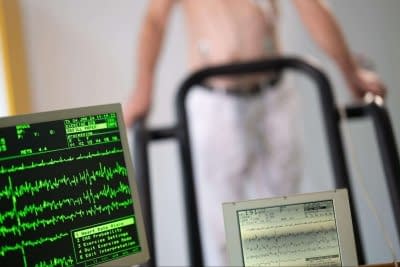
- Abnormal results on non-invasive tests: When an EKG stress test, stress echocardiography, or Coronary CTA indicates a high probability of severe narrowing.
- Preoperative preparation: Before heart valve interventions or other major cardiac surgeries, to ensure optimal blood supply during the operation.
- Heart failure of unknown cause: To determine if the weakening of the heart is caused by poor circulation.

Preparing for the procedure
To ensure the procedure is performed in complete safety, we welcome you to our cardiology clinic. Before the procedure, the patient must follow a few simple steps:
- Blood tests: Coagulation tests and renal function evaluation (creatinine) are mandatory, as the contrast dye is eliminated through the kidneys.
- Fasting: Do not consume food or liquids for at least 6 hours before the procedure.
- Usual medication: Some medications (such as oral antidiabetics or anticoagulants) may require discontinuation or dose adjustment a few days prior. This is done only under the cardiologist's guidance.
- Hydration: It is recommended to drink plenty of water the previous day to help the kidneys process the contrast substance.
- Informing the doctor: Notify the CorePrime team if you have allergies (especially to iodine) or if you suffer from known kidney conditions.
How is the procedure performed at CorePrime?
Our interventional cardiology team follows a rigorous protocol to ensure patient comfort and safety:
- Arterial access: After local anesthesia (usually at the wrist – radial artery), a small sheath is inserted through which the catheter will pass. Radial access allows for much faster recovery and increased comfort compared to femoral (groin) access.
- Catheter navigation: The physician guides the catheter (a very thin, flexible tube) under radiological control to the origin of the coronary arteries. The patient feels no pain during this stage, as the inside of the arteries lacks pain receptors.
- Contrast injection: A special substance is introduced to opacify the arteries under X-rays. At this moment, you may feel a slight warm sensation, which disappears quickly.
- Imaging: Recordings are taken from various angles to capture every detail of the coronary anatomy.
- Medical decision: If a critical narrowing is discovered, the doctor will discuss the option of performing angioplasty (stenting) immediately, turning the diagnostic procedure into a therapeutic one.
- Completion: The catheter is removed, and a compression band is applied to the wrist for several hours.
Risks of the procedure: What you should know
Although coronary angiography is a routine procedure with an extremely high success rate, like any invasive intervention, it involves certain risks. At CorePrime, your safety is our priority:
- Local reactions: Small bruises (ecchymosis) or slight discomfort at the insertion site.
- Contrast reactions: Occasionally, allergic reactions (itching, rash) or a temporary impact on kidney function may occur. Post-procedure hydration is crucial.
- Vascular complications: Rarely, significant bleeding at the puncture site or the formation of a small blood clot.
- Major risks (less than 1%): Complications such as myocardial infarction, stroke, or severe arrhythmias are extremely rare and typically occur in patients with very advanced cardiac disease.
It is important to remember that the risk of the underlying disease (e.g., an untreated heart attack) is much higher than the risks associated with the intervention itself.
Recovery: Returning to daily activities
Recovery is usually fast and easy, especially with radial access.
First hours:
- Monitoring: You will remain in the ward for monitoring. If the access was through the wrist, you can move almost immediately.
- Intense hydration: We encourage you to drink plenty of water to help the kidneys flush out the contrast dye.
At-home recommendations (first 48-72 hours):
- Physical rest: Avoid intense physical effort, lifting heavy weights, or strenuous exercise for the first 2-3 days.
- Puncture site care: Keep the puncture site clean and dry.
- Resuming medication: Your doctor will provide a clear medication schedule, especially if a stent was placed (angioplasty).
- Driving: We recommend avoiding driving for the first 24 hours after discharge.
Frequently Asked Questions (FAQ) about coronary angiography
1. What is the exact difference between coronary angiography and angioplasty?
Angiography is the diagnostic stage (visualization), while angioplasty is the treatment stage (opening the artery with a balloon and stent).
- Coronary angiography (Angiography): The diagnostic stage — visualizes the arteries and identifies where blood flow is blocked or narrowed.
- Angioplasty: The treatment stage — dilates the artery with a balloon and, in most cases, places a stent to keep the vessel open long-term.
2. How many times can a coronary angiography be repeated?
There is no fixed limit; it is performed whenever the clinical evolution (reappearance of symptoms) makes the diagnostic benefit outweigh the risks.
3. How much does it cost at CorePrime?
The cost varies based on the complexity and the need for specific materials (like stents). Please contact our reception for a personalized offer.
4. Are there warning signs after discharge?
Contact us immediately if you notice active bleeding, numbness or coldness in the limb, fever, or new chest pain.
5. Is coronary angiography a painful procedure?
Most patients describe the procedure as mildly uncomfortable, but not painful. The only more intense sensation is the small prick for the local anesthesia. During catheter navigation through the blood vessels, you will feel nothing, as the inside of the arteries has no pain receptors.
Schedule an appointment at CorePrime
Our interventional cardiology specialists are ready to provide expert advice and rapid diagnosis. Do not delay your heart health evaluation!
Choose the date and time for your next appointment